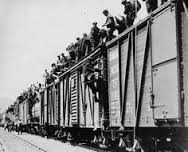
The U.S. Deported a Million of Its Own Citizens to Mexico During the Great Depression

https://www.history.com/news/great-depression-repatriation-drives-mexico-deportation

In the 1930s, the Los Angeles Welfare Department decided to start deporting hospital patients of Mexican descent. One of the patients was a woman with leprosy who was driven just over the border and left in Mexicali, Mexico. Others had tuberculosis, paralysis, mental illness or problems related to old age, but that didn’t stop orderlies from carrying them out of medical institutions and sending them out of the country.

These were the “repatriation drives,” a series of informal raids that took place around the United States during the Great Depression. Local governments and officials deported up to 1.8 million people to Mexico, according to research conducted by Joseph Dunn, a former California state senator. Dunn estimates around 60 percent of these people were actually American citizens, many of them born in the U.S. to first-generation immigrants. For these citizens, deportation wasn’t “repatriation”—it was exile from their country.

The logic behind these raids was that Mexican immigrants were supposedly using resources and working jobs that should go to white Americans affected by the Great Depression. These deportations happened not only in border states like California and Texas, but also in places like Michigan, Colorado, Illinois, Ohio and New York. In 2003, a Detroit-born U.S. citizen named José Lopez testified before a California legislative committee about his family’s 1931 deportation to Michoacán, a state in Western Mexico.

“I was five years old when we were forced to relocate,” he said. “I…bec[a]me very sick with whooping cough, and suffered very much, and it was difficult to breathe.” After both of his parents and one brother died in Mexico, he and his surviving siblings managed to return to the U.S. in 1945. “We were lucky to come back,” he said. “But there are others that were not so fortunate.”


Relatives and friends wave goodbye to a train carrying 1,500 people being expelled from Los Angeles back to Mexico in 1931.

Relatives and friends wave goodbye to a train carrying 1,500 people being expelled from Los Angeles back to Mexico in 1931.

NY Daily News Archive/Getty Images

The deportation of U.S. citizens has always been unconstitutional, yet scholars argue the way in which “repatriation drives” deported non-citizens was unconstitutional, too.

“One of the issues is the ‘repatriation’ took place without any legal protections in place or any kind of due process,” says Kevin R. Johnson, a dean and professor of public interest law and Chicana/o studies at the University of California, Davis, School of Law. “So you could argue that all of them were unconstitutional, all of them were illegal, because no modicum of process was followed.”

Instead, local governments and officers with little knowledge of immigrants’ rights simply arrested people and put them on trucks, buses or trains bound for Mexico, regardless of whether they were documented immigrants or even native-born citizens. Deporters rounded up children and adults however they could, often raiding public places where they thought Mexican Americans hung out. In 1931, one Los Angeles raid rounded up more than 400 people at La Placita Park and deported them to Mexico.

These raids were “different in some ways from what’s going on today,” Johnson says. Although the federal government in the 1930s did prosecute 44,000 people under Section 1325—the same law that criminalizes unauthorized entry today—these criminal prosecutions were separate from the local raids, which were informal and lacked any due process.

“There’s also a much more active group of lawyers advocating on behalf of immigrants [today],” he says. “In the 1930s, there was nothing like that.”

Although there was no federal law or executive order authorizing the 1930s raids, President Herbert Hoover’s administration, which used the racially-coded slogan, “American jobs for real Americans,” implicitly approved of them. His secretary of labor, William Doak, also helped pass local laws and arrange agreements that prevented Mexican Americans from holding jobs. Some laws banned Mexican Americans from government employment, regardless of their citizenship status. Meanwhile, companies like Ford, U.S. Steel and the Southern Pacific Railroad agreed to lay off thousands of Mexican American workers.

Mexican citizens entering the United States at an immigration station in El Paso, Texas, 1938. 

Mexican citizens entering the United States at an immigration station in El Paso, Texas, 1938. 

Buyenlarge/Getty Images

However, modern economists who’ve studied the effect of the 1930s “repatriation drives” on cities argue the raids did not boost local economies. “The repatriation of Mexicans, who were mostly laborers and farm workers, reduced demand for other jobs mainly held by natives, such as skilled craftsman and managerial, administrative and sales jobs,” write economists in a 2017 academic paper circulated by the non-partisan National Bureau of Economic Research. “In fact, our estimates suggest that it may have further increased their levels of unemployment and depressed their wages.”

Hoover lost the presidential election in 1932 because voters—who now referred to shanty towns as “Hoovervilles”—blamed him for the ongoing Depression (indeed, Hoover’s decision to raise import tariffs did prolong the Depression at home and abroad). The next president, Franklin Delano Roosevelt, didn’t officially sanction “repatriation drives,” but neither did he suppress them. These raids continued under his administration and only really died out during World War II, when the U.S. began recruiting temporary Mexican workers through the Bracero Program because it needed the wartime labor.

In 2005, California state Senator Joseph Dunn helped pass the “Apology Act for the 1930s Mexican Repatriation Program.” California deported about 400,000 people during that time, and the act officially apologized “for the fundamental violations of their basic civil liberties and constitutional rights committed during the period of illegal deportation and coerced emigration.”

The act also called for the creation of a commemorative plaque in Los Angeles. In 2012, the city unveiled the plaque near the site of a 1931 La Placita Park raid. The next year, California passed a law requiring its public schools to teach “repatriation drive” history, which until recently has been largely overlooked.

US Mexicans Haunted by “Repatriation”

http://news.bbc.co.uk/2/hi/programmes/crossing_continents/6191862.stm
Updated: November 26, 2006
By Linda Pressly
BBC Radio 4’s Crossing Continents

Seventy years ago, more than a million people of Mexican origin left the US in a little known “deportation frenzy” that still haunts many of them today.

Emilia
 At the station there were a lot of people crying
Emilia Castaneda

“They wanted us out of the country. I didn’t understand why when we’d been born here.“And I didn’t know anything about Mexico – my parents never talked about it.

“I remember they used to play Mexican music. But it was just music.”

Emilia Castaneda was born in Los Angeles of Mexican parents.

In 1935, she and her father and brother were forced to board a train bound for Mexico. She was nine years old.

“At the station there were a lot of people crying. I was crying too,” she said.

“I knew I wasn’t going to be able to visit my mother’s grave any more. But my dad couldn’t find employment.

“He was a man who wanted to work, but there was no work for Mexicans. The jobs were for the Anglos.”

Desperate times

This was the era of the Great Depression.

A farm worker in the 1930s

Competition for all jobs was fierce as the country hit hard times

At its height, around a quarter of the US population was unemployed.The competition for jobs was intense.

And many believed getting rid of the Mexicans would create employment opportunities for “real Americans”.

As the depression deepened, state and local governments passed laws restricting employment to native-born or naturalised citizens.

The Federal Government required all firms supplying it with goods and services to hire only US citizens.

And private companies fell in line with the prevailing anti-Mexican feeling and sacked their workers.

Francisco Balderrama, professor at California State University and co-author of Decade of Betrayal, estimates that somewhere in the region of a million people of Mexican origin were driven out of the United States during the 1930s.

Nearly two thirds of those who left were US citizens.

Emilia Castaneda was one of them. Ruben Jimenez was another.

Mexican convoy

Ruben
 A lady who travelled with us started praying from the moment we left
Ruben Jimenez

Ruben was seven years old when his family journeyed south by truck.

“It was like a caravan of Mexican families,” he said.

“I remember there was a lady who travelled with us and she started praying from the moment we left Los Angeles and continued until we got to the Mexican border.

“That is something I will never forget.”

Although Los Angeles became a focal point for what Professor Balderrama calls the “deportation frenzy”, by the time of the depression, Mexicans were a well-established part of communities all over the United States.

The census of 1930 calculated that nearly one and half million people of Mexican origin lived in the US.

They were canning fish in Alaska, harvesting sugar beet in Minnesota and assembling cars in Detroit.

Often paid much less than their white counterparts, they were seen – much as they still are today in some quarters – as a source of cheap, expendable labour.

Climate of fear

Around 50,000 people were formally deported in the 1930s.

Mexicans packing their car to go

Many Mexicans left voluntarily to avoid the humiliation of deportation

And these mass round-ups in Mexican parts of town provided the impetus for many more to leave, according to Professor Balderrama.“Sweeps were publicised in the newspapers with banner headlines and they created a reign of terror,” he said.

“Individuals worried whether a husband or wife who had gone shopping or to work would ever return.”

Hundreds of thousands left voluntarily to avoid the humiliation of deportation.

Others were driven out by harassment or violence.

Signs appeared warning Mexican residents to leave town.

And the authorities and some of America’s biggest corporations encouraged the exodus.

This was an episode in American history that was never recorded in the history books.

But that is beginning to change.

Seeking recognition

California State Senator Joseph Dunn is leading the political charge to bring these little known events into the public consciousness.

California State Senator Joseph Dunn i

Senator Joseph Dunn wants the episode better acknowledged

Earlier this year the Apology Act became law.In it, the State of California apologised to the survivors and their families.

But Governor Arnold Schwarzenegger has refused to approve Senate bills that would require schools to include the repatriation in the curriculum, and to offer victims compensation.

The coerced migration of a generation of Mexican nationals and US citizens of Mexican origins during the 1930s had a profound legacy.

Families were separated and communities destroyed.

Emilia and Ruben both returned to Los Angeles during the Second World War – Emilia to a factory job to help the war effort, Ruben to the US Military.

But their experiences as “personas repatriadas” have marked them.

“I feel a resentment because my childhood and education were interrupted,” said Ruben.

“We lost a lot. I lost the opportunity to live as an American citizen – which is what I am.”

Crossing Continents was broadcast on Thursday, 30 November 2006, at 1102 GMT and was repeated on Monday, 4 December 2006, at 2030 GMT.

NPR: America’s Forgotten History Of Mexican-American ‘Repatriation’

America’s Forgotten History Of Mexican-American ‘Repatriation’

A Forgotten Injustice


A film by Vicente Serrano
MeChicano Films

About the film

“A Forgotten Injustice” is Vicente Serrano’s opera prima, and the first documentary that uncovers the story of almost two million Mexican Americans and U.S. citizens, who were forced out of the United States during the Great Depression in the 1930s.

In the 1930s, the United States was devastated by the crash of the stock market and many officials thought that Mexicans were taking jobs and public services from “real” Americans. They came up with the idea of solving the economic problems of the country by deporting as many Mexicans as possible.

“A Forgotten Injustice” is the result of an extensive investigation headed by journalist Vicente Serrano. Serrano traveled across the country and Mexico to capture the experiences of these men and women, many still living in extreme poverty in rural areas in Mexico. Some of the survivors are coming back to the U.S almost 80 years later. “They should apologize for what they have done to us before we die and before the government commits the same mistakes,” exclaimed Emilia Castañeda who was born in Los Angeles and forced to leave the U.S with her family in the 30s.


Mexico Struggles To Integrate Foreign Students, Including U S Born Children

https://www.npr.org/player/embed/566877368/566877369


LA Unveils the Mexican “Repatriation” Apology Act Monument in 2012

The unveiling of the Mexican “Repatriation” Apology Monument in Los Angeles at La Plaza de Cultura y Artes in 2012.

The monument is to recognize Mexican legal residents in California and their American-born children who were unconstitutionally removed from their homes and deported to Mexico during the Great Depression.